Research
The MISSION project is an innovative knowledge- and industry-driven value chain to produce antibiotics by using streamlined Streptomyces rimosus (S. rimosus) cell factories. S. rimosus has proven to be a powerful industrial oxytetracline overproducer and is the most competitive strain worldwide with respect to key performance indicators such as yield, rate and titre.
Industrial high-producing S. rimosus strains have been created through many years of research. MISSION aims to create a cell factory chassis of S. rimosus with superior growth properties, high robustness and a tuneable supply of energy, redox equivalents and building blocks.
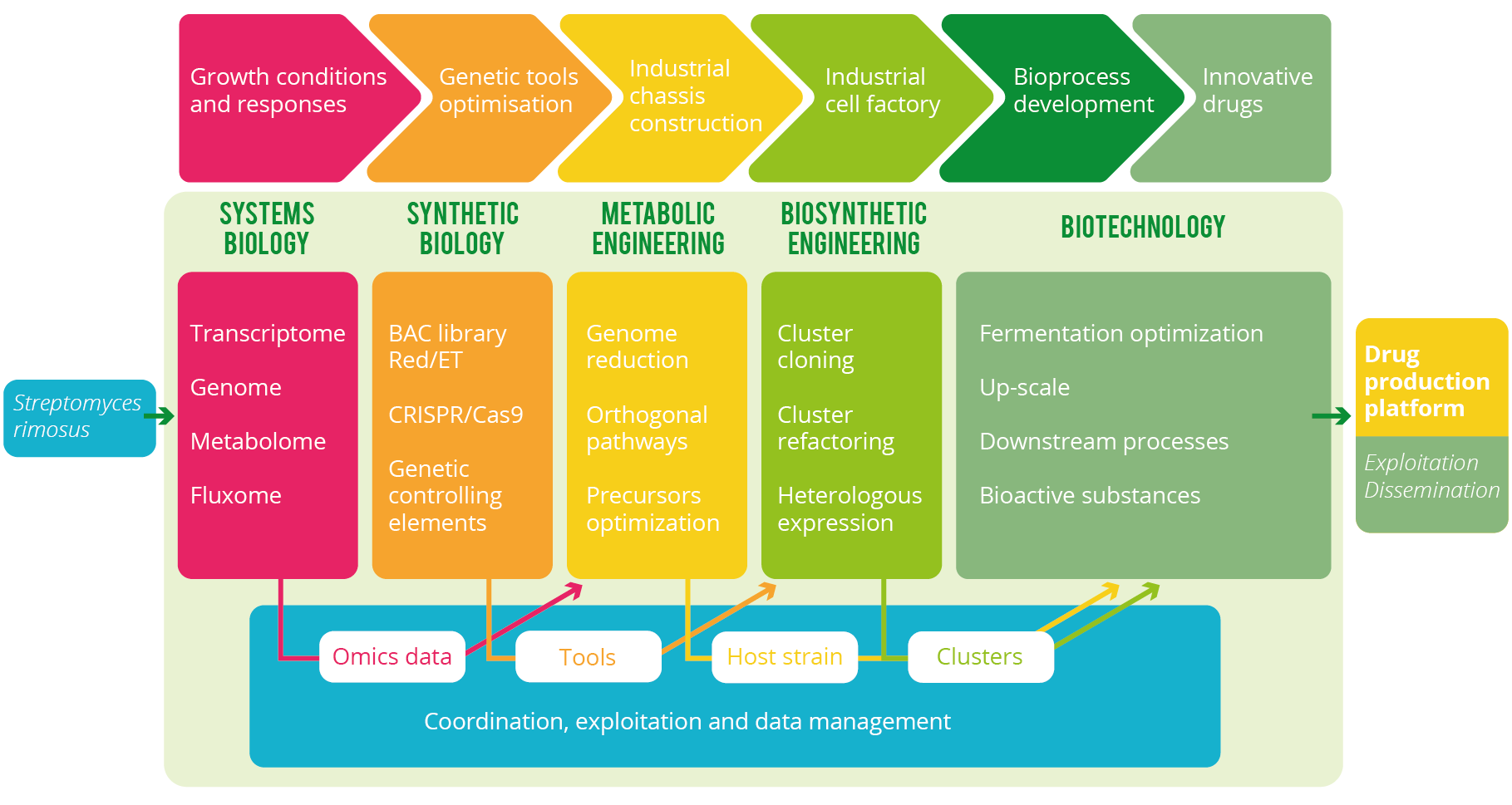
The research work plan integrates systems and synthetic biology with bioinformatics and process engineering into a purpose-driven and engineering workflow. Multi-omics analysis of this strain will deliver key insights for targeted optimisation into superior chassis. During development, the iterative and interactive combination of carefully tailored experimental and computer-modelling approaches will support the prediction of multi-combinatorial genetic traits to develop a superior microbial chassis.
A full range of new synthetic parts, such as fine-tuned promoters, terminators and regulatory circuits as well as cutting-edge CRISPR/Cas9 genetic engineering will be developed for an exact, marker-less and fast translation of identified, desired features into a clear genetic language, operated by the newly created S. rimosus cells.
In addition to biosynthetic power, project will consider cellular genetic stability, process tolerance and robustness by pre-early integration of expected needs from industrial partners into the design process.